Seedance 2.0 vs Everything Else: Why the Gap Is Bigger Than You Think
varsha April 8, 2026 0 COMMENTS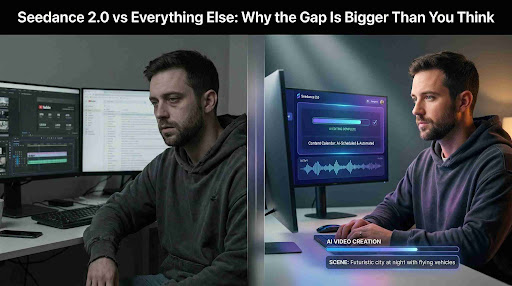
In early 2026, the AI video market is more crowded than ever. New models are being introduced almost every week, often positioned as alternatives to existing tools. Many of them focus on surface-level improvements such as clip length, resolution, or generation speed.
However, for professional creators, the conversation has already moved beyond that.
The real discussion today is about control, synchronization, and reliability. These are the factors that determine whether a tool can actually be used in production workflows rather than just experimentation.
This is where the gap becomes clear.
While many tools are still operating as basic generators, systems like Seedance 2.0 within the Higgsfield ecosystem reflect a shift toward something more structured. The difference is not just visible in output quality, but in how the entire system is designed.
The architecture trap: unified vs cascaded systems
The biggest reason behind this gap is something most users never see directly. It lies in the underlying architecture.
Most AI video tools rely on cascaded pipelines. In this setup, video is generated first. Then separate models are used to add audio, adjust motion, or force lip synchronization.
This fragmented approach leads to predictable issues:
- Audio feels slightly delayed
- Lip-sync appears forced
- Motion lacks natural alignment
These problems are not random. They happen because each component is handled independently.
In contrast, systems built within Higgsfield follow a unified approach. Video and audio are generated together from the same input rather than being stitched together afterward.
This changes how the system understands a scene.
Instead of treating audio as an add-on, it becomes part of the same structure as visuals and motion. This results in outputs that feel more cohesive and grounded.
Native audio vs reactive audio systems
One of the clearest differences between systems appears in how audio is handled.
Many tools have introduced audio features, but most of them are reactive. They analyze a generated video and try to match sound afterward.
This approach creates several issues.
One of the most common is temporal drift. Even a slight delay between sound and motion can make a video feel unnatural. In professional work, this is immediately noticeable.
Another issue is environmental accuracy. Reactive systems often apply generic sound effects without understanding the space in which the scene takes place.
In contrast, systems like Seedance 2.0 within Higgsfield generate audio natively alongside visuals.
This leads to:
- Precise alignment between sound and action
- More realistic environmental acoustics
- Better representation of physical interactions
Research such as Joint Audio-Visual Diffusion confirms that simultaneous modeling is essential for achieving realistic synchronization between audio and visual elements.
The advantage of structured control
Another major difference lies in how much control creators have.
Most AI video tools still depend heavily on text prompts. While prompts are useful for generating ideas, they are not reliable for precise direction.
If a creator needs:
- A specific character design
- A defined camera movement
- A particular tone of voice
Text alone often falls short.
Within the Higgsfield ecosystem, more structured inputs are being used to guide outputs. These include visual references, motion cues, and audio samples.
This reduces guesswork.
Instead of generating multiple variations and hoping for the right result, creators can define their intent more clearly and achieve predictable outputs.
Multi-shot narrative continuity
One of the most frustrating limitations of many AI tools is the lack of continuity.
Generating a single strong shot is possible, but maintaining consistency across multiple shots is much harder.
Common issues include:
- Characters changing appearance
- Lighting inconsistencies
- Background variations
These problems make it difficult to create structured narratives.
Seedance 2.0 addresses this by supporting multi-shot continuity within a single generation.
This allows creators to:
- Combine wide, medium, and close-up shots
- Maintain consistent character identity
- Preserve lighting and environment across cuts
Because this process is handled within the same system, it reduces the need for manual corrections.
This is one of the key reasons why workflows within Higgsfield are becoming more relevant for production use.
Efficiency as a real production metric
In professional environments, efficiency is not just about speed. It is about reducing the total effort required to produce a usable output.
Traditional AI workflows often require:
- Multiple tools
- Repeated iterations
- Manual corrections
This increases production time even if generation itself is fast.
More integrated systems reduce this overhead.
By combining multiple stages into a single process, platforms like Higgsfield allow creators to generate outputs that require less fixing.
This leads to:
- Fewer retries
- More consistent results
- Faster overall production cycles
For agencies and teams working at scale, this difference becomes significant.
Why this gap matters now
The gap between basic generators and structured systems is becoming more important as content demands increase.
Creators and businesses are expected to produce:
- High-quality visuals
- Consistent branding
- Scalable content
Tools that cannot meet these requirements may still be useful for experimentation, but they are harder to use in production environments.
This is why more workflows are shifting toward systems that focus on control and consistency rather than just generation.
From generation to direction
One of the biggest changes in AI video is the shift from generation to direction.
Earlier tools focused on producing outputs based on prompts. The creator’s role was limited to describing what they wanted.
Now, creators are taking a more active role.
They are:
- Guiding structure
- Controlling motion
- Refining outputs
AI becomes a tool that supports execution rather than replacing creative intent.
Conclusion
The gap between Seedance 2.0 and other AI video tools is not just about output quality. It is about how the entire system is built.
While many tools still rely on fragmented pipelines, more unified approaches are focusing on synchronization, control, and workflow integration.
These differences become clear in real-world use.
As the industry evolves, visual quality alone will not be enough. The platforms that succeed will be the ones that combine consistency, precision, and efficiency into a single system.
Right now, that gap is becoming more visible, and it continues to grow.



Latest Articles
 Arattai App Review: What Makes It Differ…In App
- How to set up the electronics on a fishi…In Automotive
- SYFM Meaning Explained: Is This Texting …In Social Media
- How Much Working Capital Do You Need Acc…In Business
- What Does NM Mean in Text Message? Know …In Social Media
- Best Premium Laptops for Productivity &#…In Tech
- What Does ICL Mean in Texting? Meaning, …In Social Media
- What Does Igh Mean in Text? Decode This …In Social Media